
Dry vs Wet RFID Inlays for UHF Labels
A dry RFID inlay carries the chip and antenna on a substrate. A wet inlay adds an adhesive and release liner. Choose the format that fits your converting process and verify the finished label on its intended surface.
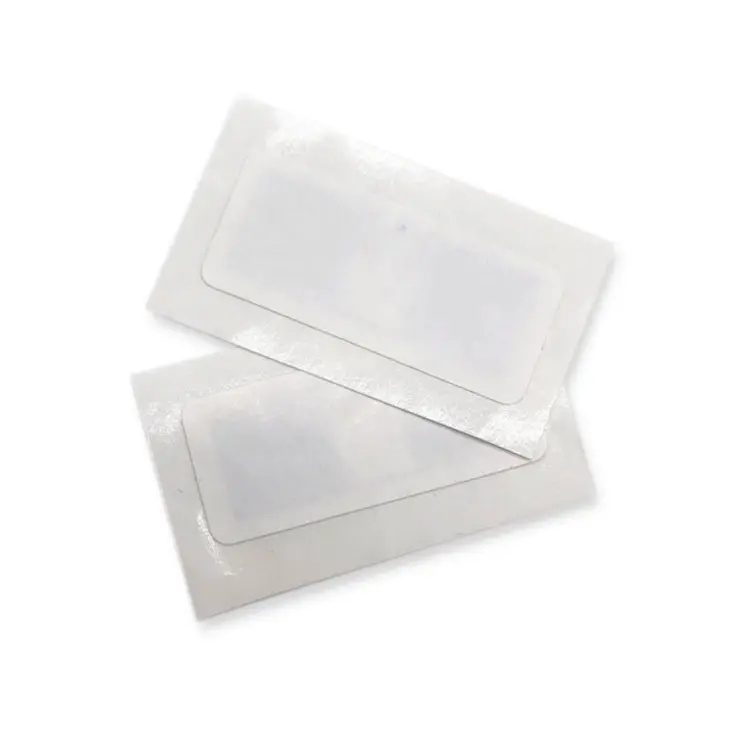
Compare the inlay and label layers
| Construction | How it is supplied | What the buyer must define |
|---|---|---|
| Dry inlay | Chip and antenna on a substrate, without adhesive backing. | Antenna footprint, substrate and the process that will combine it with the remaining layers. |
| Wet inlay | Inlay with adhesive on a release liner. | Target surface, adhesive and liner, feed direction and roll format. |
| Finished label | An inlay in a label construction with the selected face material and adhesive. | Finished dimensions, print method, encoding, application equipment and surface. |
Separate antenna dimensions from finished size
Use a drawing to record the available label footprint, the antenna keep-out area, the direction of feed and the spacing between repeats. Two catalog references below list a 68 × 19 mm antenna inside a 70 × 21 mm inlay. Compare the layer construction and confirm the chip for the selected order.
Trial the conversion and the end use
Run a short trial through the equipment that will print, encode, laminate or apply the label. Check placement and feed, then verify the encoded data and read behavior after application to the actual item. Test different positions when the item’s shape, contents or surrounding materials vary.
Catalog examples
Flexible Passive UHF RFID Dry Inlay
The original listing includes a construction diagram that compares a dry PET inlay with adhesive-backed and coated-paper examples.
Use this model in a sample requestMonza 4QT UHF Dry Inlay
The dry reference lists Monza 4QT, a 70 × 21 mm inlay and a 68 × 19 mm antenna.
Use this model in a sample request860–960 MHz UHF Wet Inlay
The wet reference shows the same listed dimensions and names Monza 4QT. Confirm the exact chip, adhesive and liner before selecting it.
Use this model in a sample request
What to include in your request
- Chip, region, reader model, antenna footprint and finished label drawing
- Substrate or item surface, adhesive needs and any printable face material
- Converting process, web width, repeat pitch, core size and unwind direction
- Encoding, verification method, sample length and forecast volume
Technical references
Primary technical reference for the construction of dry and adhesive-backed wet inlays.
Avery Dennison inlay selection guide